
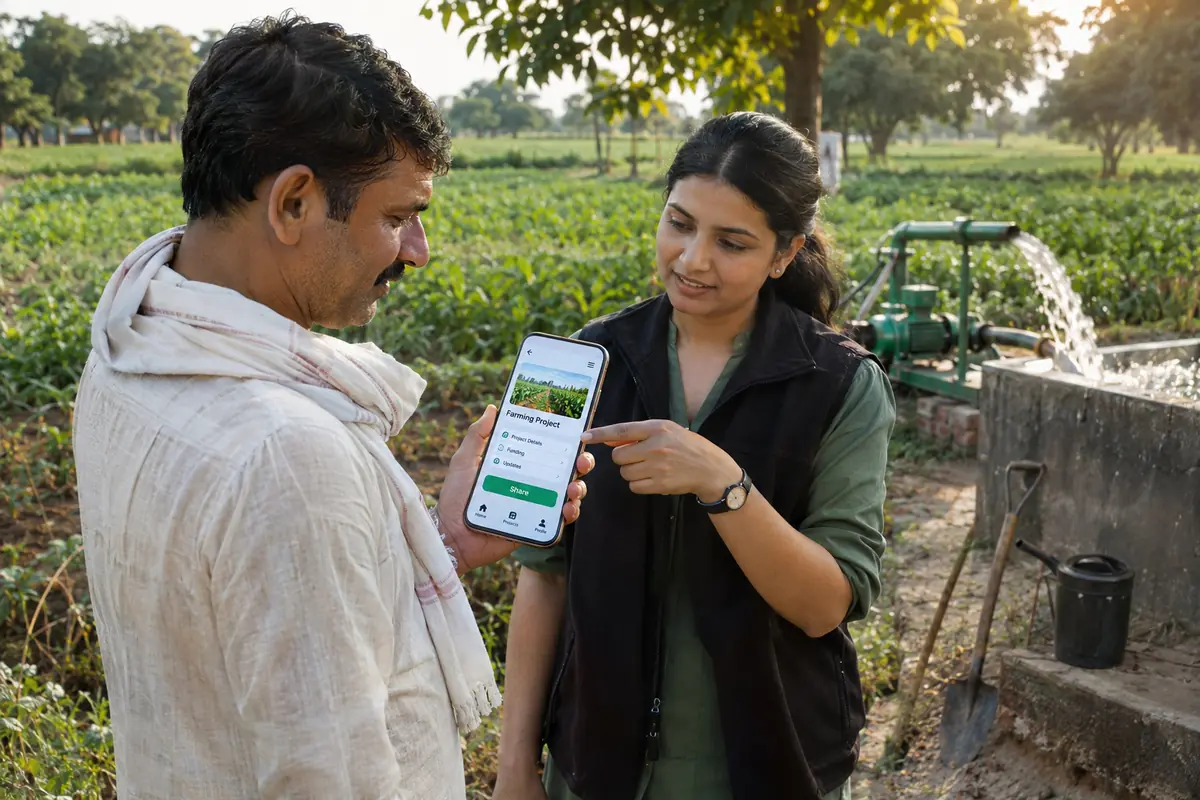
India P2P farmer loans are small, short-tenor advances in which individual lenders fund a grower or fisher through a registered online platform, as a supplement to conventional agricultural finance. They can cover seed, fertiliser, a pump set, a cattle purchase or equipment repairs. Such platforms are NBFC-P2P entities licensed by the Reserve Bank of India, and they sit alongside crop loans from cooperative and commercial banks, not in place of them. Because farm income arrives in seasons, the repayment schedule matters as much as the amount borrowed.
Who borrows and why
Indian agriculture is dominated by small and marginal holdings, often a hectare or two worked by a family. Cash is needed before the harvest, when seed, fertiliser, labour and irrigation have to be paid for, and income arrives only after the crop is sold. That gap is where short credit is most useful.
Borrowers range from vegetable growers near a city to dairy keepers, poultry farmers, fish farmers and orchard owners. Tenant farmers and sharecroppers, who often lack land records, find formal bank credit hardest to obtain and are the most likely to look at alternatives.
India P2P farmer loans agricultural finance: key points before you decide
- Quality seed, saplings, fertiliser and crop protection before sowing.
- Hiring labour or machinery at peak operations such as transplanting and harvest.
- Repair or purchase of a pump, sprayer, drip kit or small power tiller.
- Feed, vaccination and shed repairs for dairy animals and poultry.
- Working capital for a farm-gate processing or grading activity.
Large purchases such as a tractor or a new borewell usually exceed what a peer platform can arrange and belong with banks, cooperatives or equipment finance.
Agricultural finance is wider than field crops. Fish farmers need money for fingerlings, feed, pond preparation and nets, and coastal fishers need it for boat repairs, engines and ice. Dairy keepers buy animals, fodder and milking equipment, while poultry growers pay for chicks and feed before a batch is sold.
Cash cycles differ sharply. Milk brings daily income, a poultry batch pays out in weeks, and a fish crop in months. A short peer loan fits the quicker cycles better than the slower ones, and borrowers should match the term to the activity rather than to what a platform happens to offer.
How regulated platforms operate
An NBFC-P2P platform introduces lenders to borrowers, assesses the borrower, collects instalments and passes them on. It must hold a Certificate of Registration from the Reserve Bank of India, cannot lend from its own balance sheet and cannot guarantee repayment or promise assured returns.
The framework limits one borrower's total outstanding amount across platforms to Rs 10 lakh, a lender's exposure to a single borrower to Rs 50,000, and loan maturity to 36 months. Most farm needs fit comfortably inside those caps, but a lender can still lose money, and that risk is not removed by registration.
Matching repayment to the crop cycle
The most common cause of distress is an instalment calendar that ignores when the farm earns. A monthly schedule suits a dairy keeper with daily milk sales, but it can strain a paddy grower who is paid once or twice a year.
A borrower should map expected sale dates, mandi price swings and input costs before accepting a term. Where a platform allows a longer gap or a balloon at harvest, that fits seasonal income better than equal monthly payments. Weather risk, pest attack and price falls should be assumed, not hoped away, so the amount borrowed should leave a cushion.
Costs and checks before signing
A farm advance is cheaper or dearer depending on the whole bundle of charges, not just the headline rate. Platforms may levy a processing fee, a late-payment charge and a service fee on the lender side that affects the borrower's net outflow.
- Ask for the annualised cost and the total sum to be repaid in rupees.
- Check whether partial prepayment is allowed without a penalty.
- Find out how reminders and recovery calls are handled and by whom.
- Keep a copy of the signed or e-signed terms.
A farmer who cannot explain the repayment figure to a family member probably should not sign yet.
Fake lending apps target rural users with quick approvals, fees collected in advance and aggressive recovery messages. A borrower should confirm the legal entity, the RBI registration and the physical address before sharing documents or granting phone permissions.
Read the schedule line by line, ask for a total repayment figure, and never pay a processing fee to a person who contacts you on a messaging app. Information here is general; it is not personal advice or an offer of credit.
Lender perspective: backing a grower
People who lend through a platform choose among borrowers and spread their money. A lender should assume that some farm loans will be repaid late or not at all, because weather, pests and prices are outside any borrower's control.
Spreading small amounts across many borrowers, staying well inside the per-borrower and aggregate caps, and never lending money needed for household needs are basic habits. No platform may promise a fixed return, and any return advertised as certain is a warning sign rather than a feature.
Existing support the farmer should explore first
Public and cooperative channels often cost less than any private source. Primary agricultural credit societies and rural banks extend crop loans, and the Kisan Credit Card offers a revolving limit tied to cultivation needs. Government schemes may provide interest subvention or insurance for crops.
- Check eligibility for a Kisan Credit Card at the nearest bank branch or cooperative society.
- Ask about crop insurance enrolment, since a failed harvest can otherwise wipe out a small loan plan.
- Keep land records, tenancy proof or village-level certificates ready.
- Use peer funding for gaps that these channels do not cover.
Interest-free options in farming communities
Many rural communities run informal Qard Hasan arrangements in which a neighbour or a committee advances money and takes back only the principal after harvest. Sharia-minded cooperatives sometimes use a fixed service fee to cover costs, and some structure input supply as a deferred-payment sale.
These are community, charitable or cooperative systems, not RBI-registered NBFC-P2P apps. Their strength is local knowledge of the borrower; their weakness is the absence of formal recovery and dispute handling, so written notes and witnesses protect everyone involved.
Frequently asked questions
Can I get a P2P loan for farming without owning land?
Platforms look at repayment ability, not only land title, so a tenant or sharecropper may be considered. Income evidence, bank statements and a clear purpose are still needed, and approval is never assured. Lower amounts and shorter terms are more realistic.
How should I time repayments if my income comes once a year?
Ask for a schedule that matches your selling season, such as a payment at harvest, rather than equal monthly instalments. Plan for price falls and weather loss, and borrow less than the maximum offered so a poor season does not turn into default.
Are interest-free loans for farmers available through registered apps?
Registered NBFC-P2P apps normally charge a return to lenders. Interest-free help in India mostly comes through community, charitable or cooperative groups using Qard Hasan, which are not RBI-registered platforms and rely on trust and written agreements.
Further reading
- NABARD : NABARD supports agricultural and rural development finance through cooperatives and rural banks, so it is a relevant starting point for growers comparing peer funding with institutional farm credit.