
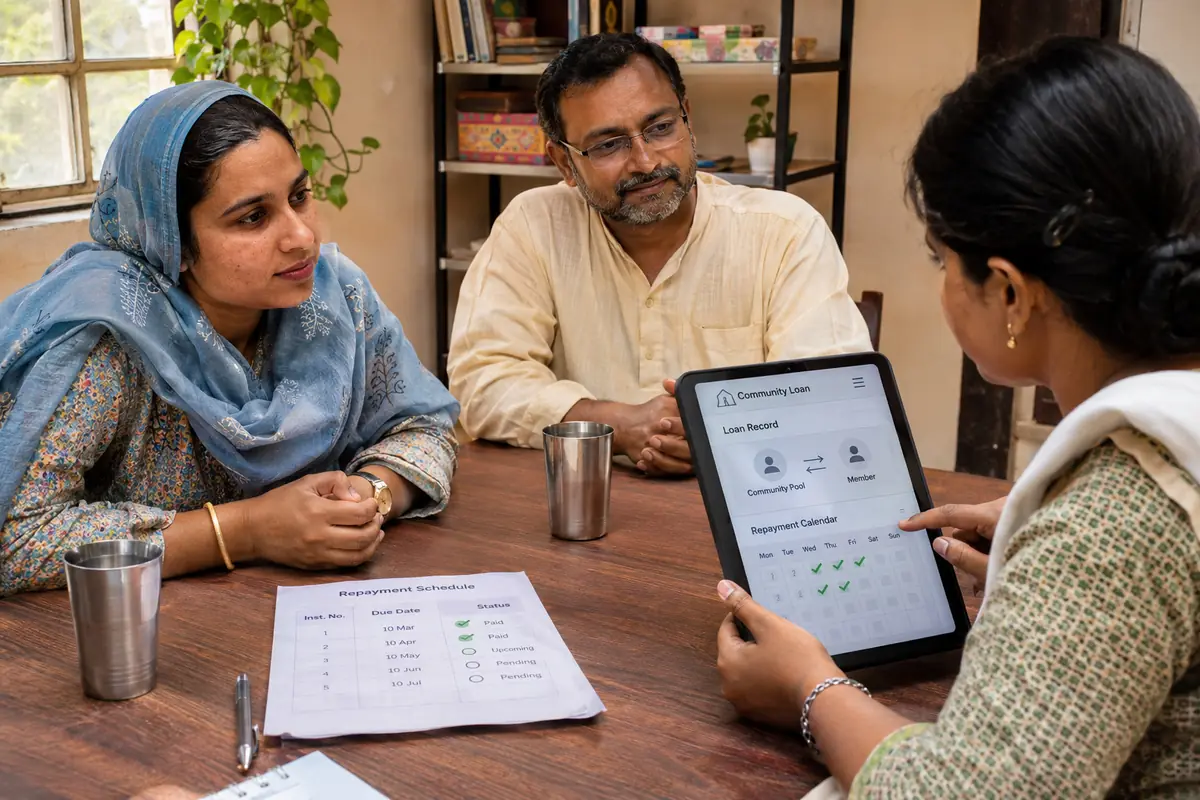
India Qard Hassan interest-free P2P loans are benevolent loans passed directly from one person or fund to another, where the borrower returns exactly the amount received and the lender expects no predetermined return. The concept rests on the Islamic principle of qard hasan, a good loan, and it differs sharply from interest-bearing credit in both purpose and spirit. In India most such lending happens through families, mosques, trusts and cooperatives, while RBI-regulated NBFC-P2P apps operate for profit and normally charge interest on their loans.
The meaning of a good loan
Qard Hassan, also written Qarz-e-Hasana, is a loan given for the sake of God. The Quran encourages believers to lend a goodly loan, and Islamic law treats it as an act of charity that still creates a debt.
The borrower must repay the principal, and the lender may not demand more. If the borrower adds a voluntary gift at repayment with no prior agreement, scholars generally accept it, but it cannot be stipulated in advance.
This is the key distinction from riba. A conventional lender prices time and risk; a Qard Hassan lender gives time and accepts risk for spiritual reward.
India Qard Hassan interest-free P2P loans explained step by step
Lenders include relatives, friends, employers and members of a community who have surplus funds. Trusts and societies collect donations and deposits to build a pool from which they lend.
A request normally covers the amount, the purpose, the repayment date and the borrower's means. Lenders tend to favour urgent and productive needs. A borrower who is open about other debts is more likely to be trusted.
- state the exact sum and not a range
- explain how repayment will be made
- provide references or a guarantor if requested
- accept that a fund may have a waiting list
Because lending is voluntary, a refusal carries no stigma and should be accepted politely.
Long-standing community institutions
Some communities in India have run organised interest-free loan trusts for generations. They gather contributions, assess requests by committee and lend for education, housing repairs, marriages, business and health.
Their strength lies in discipline: members know that repayment keeps the fund alive for others. Membership rules, caps on amounts and guarantor requirements vary from institution to institution.
Such bodies are governed by trust law or cooperative law and not by the RBI's NBFC-P2P framework, so borrowers should read the rules of each organisation carefully.
Purposes that attract benevolent lending
Funds and individuals tend to prioritise needs that protect dignity and livelihood. Medical treatment, education fees, housing repairs, marriage costs and a small business start are the most common.
Lending for luxury or speculation is less likely to receive support. A borrower who explains the benefit to his family, and who has tried to save first, shows seriousness.
Priority also tends to go to those who cannot use formal credit: workers without payslips, self-employed people without accounts and families with no collateral. This is where Qard Hassan fills a real gap in the Indian financial system.
Service fees and what is permitted
Running a fund costs money for staff, premises and record keeping. Many scholars permit a fixed administrative fee when it covers actual costs and does not rise with the amount or the time taken.
The fee must be disclosed at the start, and it must not turn into a disguised return. A fee that grows each month a borrower holds the money looks like interest and is generally rejected.
Late-payment charges are another sensitive area. Some funds ask a defaulter to donate a sum to charity, which does not enrich the lender, while others simply keep reminding. Borrowers should ask for the policy before taking money.
How P2P platforms in India differ
Peer-to-peer platforms are licensed by the Reserve Bank of India as NBFC-P2P and must hold a Certificate of Registration. They act as intermediaries, cannot lend from their own balance sheet and cannot guarantee repayment or promise assured returns.
Limits apply: Rs 50 lakh maximum lender exposure across platforms, Rs 10 lakh maximum outstanding borrowing for one borrower, Rs 50,000 maximum for one lender to the same borrower and 36 months maximum maturity.
Lenders on these apps seek a return, so the loans are priced with interest. They are not Qard Hassan, even when a marketing message uses religious language. A platform advertising interest-free loans should be examined with extra care.
Recording the loan and settling disputes
The Quran advises writing down debts with a fixed term, and this guidance remains practical. A short note should name both parties, the amount, the date and the repayment schedule, and be signed before witnesses.
If a dispute arises, the parties should first talk directly. A respected elder, imam or community mediator can help find a fair solution. Legal action is a last resort, but a written record makes it possible.
Where a borrower is in genuine hardship, Islamic teaching encourages the lender to grant more time or to forgive part or all of the amount, which is regarded as a form of charity.
Digital tools and modern practice
Technology has begun to reach community lending. Groups use messaging apps to collect requests, spreadsheets to track balances and bank transfers for receipts. This improves transparency and allows donors in different cities to participate.
Technology also brings fraud. Imitators use religious names to attract deposits, and fake funds promise quick approval for a fee. A borrower or donor should confirm that an organisation has a physical presence, a legal registration and a record of published accounts.
Even small groups benefit from a written constitution, named office-bearers and an annual statement shared with contributors.
Responsibilities of the borrower
The borrower holds an amana, a trust. Delay in repayment without a good reason is treated as wrongdoing in Islamic teaching, while an honest request for more time is respected.
- repay at the agreed date or inform the lender early
- use the money for the stated purpose
- keep a receipt for each repayment
- avoid borrowing from several funds for the same need
- pray for and thank the lender, which is encouraged
Where a borrower dies with a debt, the heirs are expected to settle it from the estate before distribution, and many lenders may waive part in kindness. Written records make this process simpler.
Safety checks before taking part
Whether borrowing or giving, due diligence applies. Verify the legal identity of the fund or app, ask for written terms and keep copies. Never pay to obtain a loan, and avoid platforms that demand access to contacts or photographs.
A lender should lend only what he can afford to lose, since there is no guarantee. A borrower should consider the lender's feelings and keep the relationship honest.
This information is general. It is not personal advice and does not offer any loan.
Frequently asked questions
What does Qard Hassan mean in India?
It means a good, benevolent loan in which the borrower returns only the amount received. The lender expects no predetermined return. In India it is offered by families, trusts, cooperatives and community funds.
Are RBI-registered P2P apps Qard Hassan lenders?
No. Licensed NBFC-P2P apps connect lenders who expect a return, so their loans carry interest. Genuine Qard Hassan funds are community or charitable systems and are not regulated as P2P platforms.
Can a Qard Hassan fund charge a fee?
Many scholars allow a fixed administrative fee that covers genuine running costs, if disclosed in advance and not growing with time or amount. A fee that works as a return on the loan is not accepted.
Further reading
- Burhani Qardan Hasana (Dawoodi Bohra community) : Burhani Qardan Hasana is a long-standing community trust offering interest-free loans, giving a real example of how organised Qard Hassan lending works in India.