
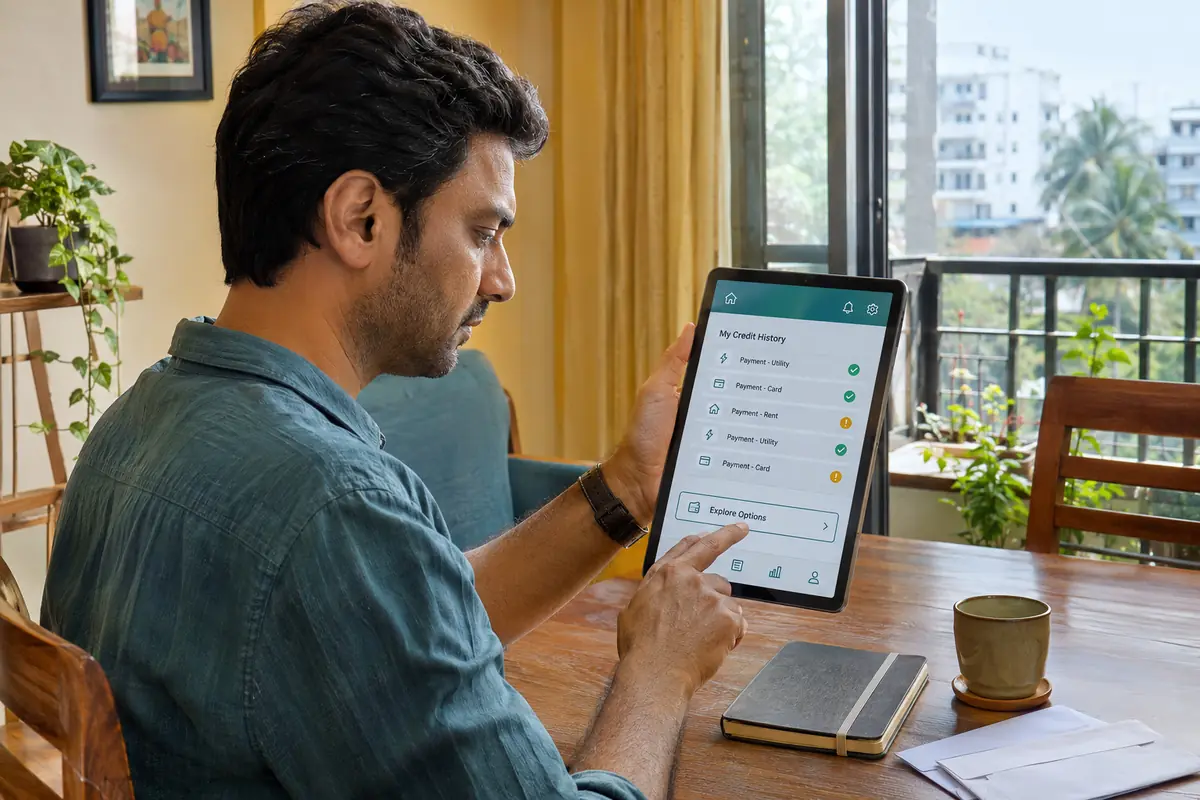
India P2P loans with bad credit are small unsecured advances sought by borrowers whose credit score is low because of missed payments, defaults or heavy card use, and who have been turned down by banks. Regulated NBFC-P2P platforms are licensed by the Reserve Bank of India and may consider applicants with imperfect records, but they price the extra risk through higher charges or smaller amounts. A loan like this is a tool for managing a temporary problem and should come with a plan to repair the record.
How a credit score is built
In India the best-known score is the CIBIL score, a three-digit number, usually between 300 and 900, produced by a credit bureau from the repayment history reported by banks and finance companies. Payment record, the share of available credit in use, the age of accounts, the mix of loans and the number of recent applications all feed into it.
A low score signals risk, not character. A single missed instalment, a guarantee for someone else's loan or a card left unpaid can drag it down, and errors in the report can do the same.
Different bureaus may show slightly different numbers, because lenders do not always report to every one of them. A borrower should check the report, not only the score, since the report lists each account, its status and the enquiries made.
Settled or written-off accounts remain visible for years and tell lenders that a past debt was not paid in full. Paying an account off in full, even late, is generally viewed more favourably.
India P2P loans with bad credit: key points before you decide
Peer platforms take a wider view than a bank's score cut-off. They may look at present income, bank balance behaviour, the stability of employment and how recently the problems occurred. A person whose arrears are three years old and who now earns steadily is a different case from one with fresh defaults.
Approval is never assured. The amount is often smaller, the term shorter and the charge higher, and a co-applicant with a better record may be requested.
Self-employed applicants may be judged on bank turnover rather than payslips, while salaried applicants may be assessed on employer type and tenure. A guarantor with a good record can improve chances, but the guarantor takes on a real obligation and should understand it before agreeing.
What the RBI framework sets
NBFC-P2P platforms need a Certificate of Registration from the Reserve Bank of India. They cannot lend out of their own funds and cannot guarantee repayment or promise assured returns. The limits include Rs 10 lakh of total outstanding borrowing for one borrower across platforms, Rs 50,000 from one lender to the same borrower, and a maximum maturity of 36 months.
A platform that advertises guaranteed approval for every credit score, or a certain return for lenders, is breaking the spirit of those rules.
The real cost of a higher-risk loan
- A higher rate than a prime borrower would pay, reflecting the chance of default.
- Processing fees and platform charges, sometimes deducted before the money reaches the account.
- Late-payment charges, which can quickly erase the benefit of a small loan.
- The effect on the score if instalments are missed again.
Ask for the full repayment figure in rupees and compare it with the amount received. If the gap is large compared with the loan's size and duration, the loan is probably too expensive for the problem it solves.
A useful test is to ask what the loan achieves. If it only delays an unpaid bill by a month at a high price, the borrower may be better off negotiating a payment plan with the original creditor, which usually costs nothing.
Steps that repair a score
- Obtain your free credit report from the bureau and check for wrong entries; raise a dispute for any errors.
- Clear overdue amounts first, and negotiate settlements in writing with the lender.
- Keep card usage well under the limit and pay at least the full amount due.
- Avoid many loan applications in a short period, since each enquiry is recorded.
- Keep old accounts in good standing, because a long history helps.
Improvement is gradual, usually over many months of steady behaviour rather than weeks.
Setting automatic payments for at least the minimum due avoids accidental lapses, and a small secured card or a loan against a deposit, repaid regularly, can add positive history for someone with few current accounts.
Interest-free community alternatives
Community and charitable groups sometimes lend on a Qard Hasan basis, meaning only the principal is repaid and the lender expects no profit. They typically do not check bureau scores and instead rely on local reputation and the stated need, which can help a person with a poor record but a good name in the neighbourhood.
These are not RBI-registered NBFC-P2P apps and have no bureau reporting, so on-time repayment will not improve the formal score unless the group reports it. Keep a written note and witnesses.
Warning signs of predatory offers
Borrowers with poor scores are a prime target for fake apps. Typical red flags are fees demanded before disbursal, pre-approved loans offered by unknown callers, requests for contacts and photographs, and abusive recovery by messages to family and colleagues.
Verify the legal entity, its RBI registration and its grievance contact. Never pay a person who asks for money to raise your score, since no outsider can legitimately change a bureau record for a fee.
Genuine platforms disclose the cost, the schedule and a grievance contact in writing before any money moves. If the app hides these or changes the amount after approval, stop and report it through the official complaint channels.
Borrowing with a plan
Before taking a loan, write down the purpose, the amount needed and the monthly sum that can be paid without new debt. If the purpose is to clear another debt, check whether it truly lowers the total cost. Borrow only what is needed and avoid rolling one loan into another.
A borrower with a damaged record should also keep a short list of fallback options, such as a family advance, a negotiated delay with the existing lender or a community Qard Hasan, so that a rejection does not push them toward the first unregulated offer received.
Frequently asked questions
What CIBIL score is considered low in India?
Scores range from 300 to 900, and lenders usually treat figures under about 650 as risky, with many preferring 750 or more. There is no single national cut-off, because each lender and platform applies its own policy.
Can a P2P platform ignore a bad credit history entirely?
Not normally. Registered platforms assess repayment risk and may consider income and recent behaviour alongside the score, but they still price or limit lending to weaker borrowers. Promises of approval for everyone are a warning sign.
Will repaying a P2P loan on time improve my credit score?
It can, if the platform reports repayments to a credit bureau. Ask in writing whether this happens before applying, since informal and community loans usually do not appear on a report and so do not change the score.
Further reading
- TransUnion CIBIL : TransUnion CIBIL issues credit scores and reports in India, so borrowers can use it to check their record, spot errors and track the effect of better repayment habits.