
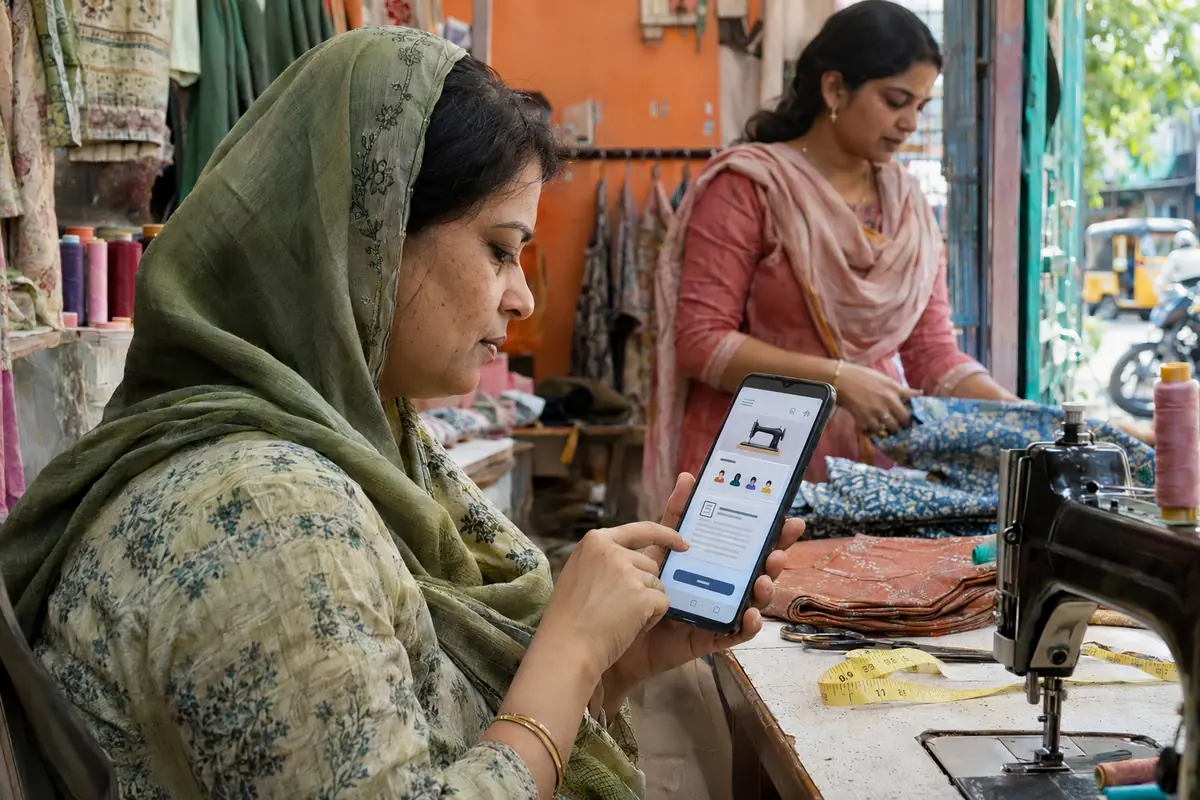
India Islamic P2P microcredit for low-income borrowers means very small loans, often a few thousand rupees, passed between individuals or from a community fund without conventional interest. It serves daily-wage workers, street vendors, home-based earners and households short of cash for an emergency or a tiny trade. Regulated NBFC-P2P platforms under the Reserve Bank of India price loans with interest, while genuine Qard Hasan microcredit works through mosques, trusts and cooperatives that ask only for the principal back and may charge a small service fee.
Who needs microcredit
The people who need very small loans are rarely visible in formal finance. A fruit seller needs money to buy stock before the morning market. A tailor needs a second-hand sewing machine. A rickshaw puller needs funds for a repair that keeps him earning.
Households also need small sums for urgent bills, school uniforms or a medical visit. Their income arrives daily or weekly and varies, so monthly instalments set by banks do not fit well.
Informal moneylenders fill the gap at very high rates, which can trap families in debt for years. An interest-free alternative is therefore both a religious preference and a practical protection.
India Islamic P2P microcredit low-income borrowers: key points before you decide
Across India, mosques, welfare societies and charitable trusts maintain small revolving funds. Contributors give money that is lent to a member in need and then lent again when repaid, so the same rupees help many families over time.
The loan is typically small and short. Repayment may be in weekly or monthly instalments, scaled to the borrower's earnings. Some funds accept repayment in kind or by labour in exceptional cases.
Funds are run by volunteers who know applicants by reputation, which replaces credit scoring. This closeness makes decisions quick and flexible, although it also means that records should be kept carefully to avoid misunderstandings.
Typical loan sizes and purposes
Microcredit amounts are small by design. A few thousand rupees may buy vegetables for a week, a pressure cooker for a tea stall or school books for a child. Slightly larger sums may buy a sewing machine, a goat or a handcart.
Because the amounts are small, repayment is usually frequent and short. A borrower who earns daily may repay in tiny daily or weekly amounts, which suits the pattern of income better than a single monthly payment.
Funds often favour productive loans, but many also accept urgent household needs, since a family that falls ill or loses a wage may otherwise turn to a harsh lender.
Self-help groups and cooperatives
Many low-income women in India save through self-help groups. Members contribute a small amount every week or month, and the pooled savings are lent to members for needs and small businesses.
Some groups follow interest-free rules, with only a fixed service fee to cover costs, while others charge interest. Islamic cooperatives and credit societies exist in several states, though their size and legal form vary.
- membership and regular saving build the group's fund
- loan amounts are linked to savings and conduct
- meetings keep accounts open to every member
- group pressure and support encourage repayment
These structures show that trust and discipline can replace collateral when a community acts together.
What regulated P2P platforms offer low-income users
Licensed peer-to-peer platforms are NBFC-P2P entities registered with the Reserve Bank of India. They cannot lend their own funds or guarantee repayment. Rs 10 lakh is the borrower ceiling across platforms, Rs 50,000 the maximum a lender may place with one borrower, and 36 months the longest term.
A very small loan may not be worth a platform's cost, and an applicant without a smartphone, bank account or documents may not qualify. Since lenders expect a return, loans carry interest, which does not meet a strict interest-free requirement.
Borrowers should compare total costs carefully and avoid short-term, high-fee loans that appear convenient but multiply quickly.
Women and household enterprise
Women make up a large share of microcredit borrowers in India. Many run home-based work such as stitching, embroidery, food preparation, tuition or small retail.
Small interest-free loans give them control of an income without exposing the household to the debt traps of informal lenders. Group guarantees and regular meetings add support and accountability.
Training in marketing, pricing and basic accounts helps a home enterprise grow. Where tradition limits movement, online selling and home delivery can open new customers without requiring a shop.
Zakat and support that needs no repayment
For families in genuine hardship, a loan may not be the right tool. Zakat, given by eligible Muslims to categories of recipients including the poor and the indebted, can provide help without any repayment.
Charities may also provide tools, stock or training in place of cash, giving a worker a lasting source of income. Apprenticeship and skill schemes raise earning capacity more reliably than a loan taken to cover consumption.
A sensible approach combines a grant for urgent needs, a small interest-free loan for productive purposes and savings for the future.
Using a small loan well
The most productive uses of microcredit are those that raise income: stock for a stall, tools for a trade, a cart or an animal for livelihood. Emergency loans are different, because they do not generate cash to repay.
- write down expected extra earnings from the loan
- decide the instalment before accepting the money
- keep a small saving from each day's income
- avoid using one loan to repay another
- tell the lender early if repayment becomes difficult
Keeping a notebook of daily sales and expenses is a simple habit that shows whether the loan is working.
Fraud, harassment and legal protection
Low-income borrowers are targeted by predatory apps and agents. Unregistered apps may demand access to a phone's contacts and threaten shame to force payment. Such conduct is not allowed, and complaints can be lodged with the police and the regulator.
Borrowers should verify the legal identity and RBI registration of any lender, never pay a fee to receive a loan and always keep a receipt. Where community funds are involved, written confirmation of the amount and schedule protects both sides.
Charitable legal-aid centres in many districts can explain a borrower's rights free of charge.
Building financial resilience
Credit is only one part of stability. A small emergency fund, insurance where affordable and a bank account in the borrower's own name reduce the need to borrow in a crisis.
Digital payments and basic financial literacy classes help borrowers keep records and avoid cheats. Over time, a clean record with community lenders and a documented income can open the door to larger formal finance.
Frequently asked questions
Can very poor families get interest-free loans in India?
Yes, usually through community Qard Hasan funds, mosque committees, charitable trusts and some cooperatives. Amounts are small and approval depends on need, local reputation and references. Regulated P2P apps generally charge interest.
Is microcredit the same as zakat?
No. Microcredit is a loan that must be repaid, though without interest in an Islamic arrangement. Zakat is a charitable obligation given to eligible recipients, such as the poor, and carries no repayment.
How can a low-income borrower avoid loan app fraud?
Check that the lender is a registered NBFC-P2P or an established community fund, never pay a fee to get a loan, refuse apps demanding contact access and keep receipts for every payment.
Further reading
- SIDBI : SIDBI supports microfinance institutions and small enterprises across India, which makes it a useful reference for how small-ticket credit reaches low-income households and tiny businesses.