
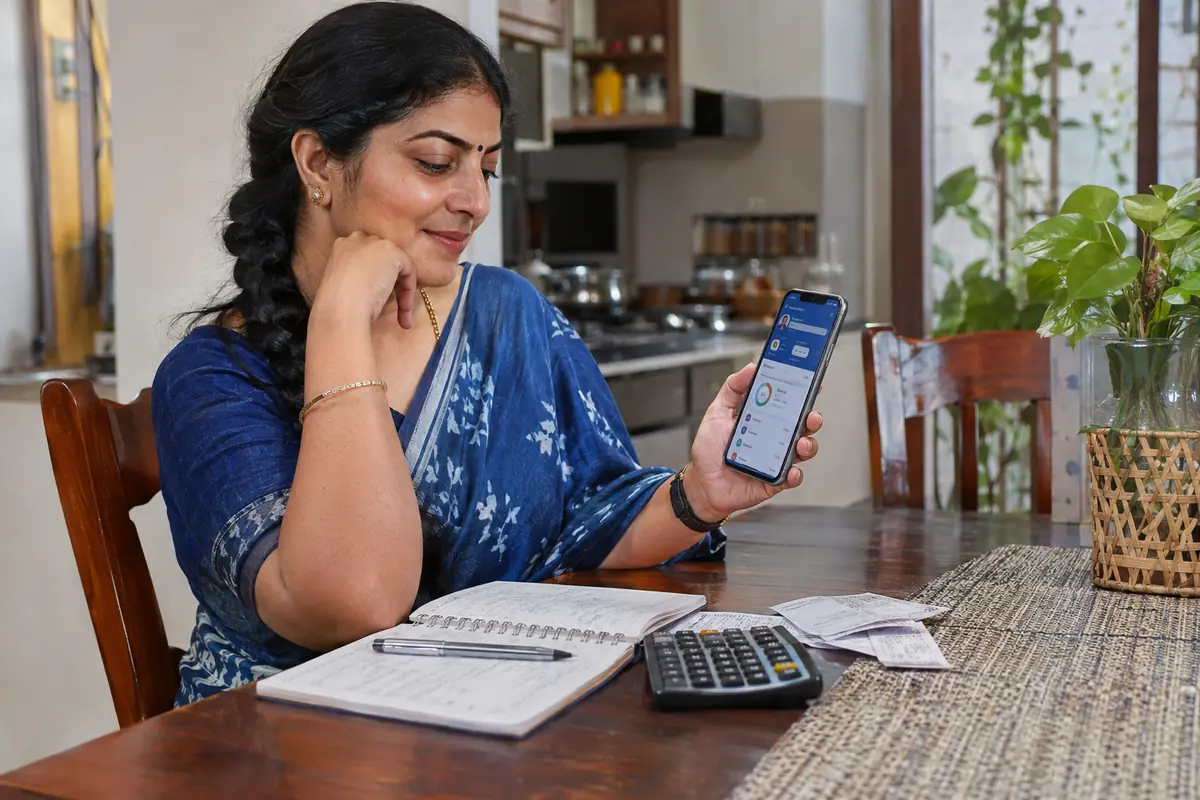
India P2P personal loans for housewives are small unsecured advances requested by women who manage a home and have no salary slip, funded by private lenders through a registered online platform or by a women's community group. Because lenders look for repayment ability, approval often rests on a spouse's income, a co-applicant, savings or a small home-based activity. The money may fund a household need, a child's school costs or the start of a modest business, and it should always be borrowed with a clear repayment plan.
Unpaid work and credit access
Running a household is full-time work, but credit systems measure income that appears in a bank account. A homemaker with no earnings can find that lenders see no repayment source, even when the family is financially stable. That is why many women are asked to bring a co-applicant, usually a spouse or a parent, or to show a separate income stream.
Women also tend to have thinner credit histories, since accounts and cards are often held in a husband's name. Building a record in one's own name is a long-term advantage.
India P2P personal loans for housewives: what to check first
- Own identity documents and a bank account in the woman's name, with regular activity.
- Any income, however small, such as tuition, tailoring, tiffin service, rental share or craft sales.
- A co-applicant's salary and credit record, if one is required.
- The stated purpose, the amount and the term requested.
Honest information matters more than a polished application. Overstating income may win approval but can trap a borrower in instalments she cannot meet.
Where a co-applicant is asked for, the woman should understand that his or her income and credit record become part of the decision, and that missed payments affect both records. Discuss the responsibility honestly before applying.
Small, regular savings in a recurring deposit also help, because they show discipline and give the lender comfort that the borrower can set money aside every month.
Common reasons women borrow
Typical needs include school or coaching fees, a medical expense, repairs at home, a family function, or the purchase of equipment such as a sewing machine, a mixer grinder for a food business or a laptop for online work. Some borrowers want working capital for a home kitchen or a boutique run from a spare room.
Loans for consumption and loans for earning are different. A loan that raises income can repay itself, while a loan for a celebration must be repaid from the existing budget, so the second type should stay smaller.
A short written plan helps even for a small loan: the expected cost, the date the money will be needed, the expected extra income and the first date of repayment. Women who sell food, stitched clothes or handicrafts often find that a plain notebook of daily sales makes the case to a lender much clearer than a verbal description.
The regulatory frame
An NBFC-P2P platform must hold a Certificate of Registration from the Reserve Bank of India. It cannot lend from its own balance sheet and cannot guarantee repayment or promise assured returns to lenders. Aggregate limits apply: a borrower can have at most Rs 10 lakh outstanding across platforms, a lender can place at most Rs 50,000 with one borrower, and loans end within 36 months.
Registration is a safeguard, not a promise. Borrowers should read the schedule, note late-payment charges and keep records of every transfer.
Women who borrow through a platform should also know how grievances are handled. A registered entity must name a grievance officer, and unresolved complaints can go to the RBI's complaint channel. Keep screenshots and emails as evidence if a dispute arises.
Other routes designed for women
India has a strong tradition of women's self-help groups, microfinance institutions and cooperative societies that lend to women, often at group level with weekly or monthly meetings. Public schemes and bank programmes for women entrepreneurs may offer collateral-free credit and training.
- Join or form a self-help group linked to a bank branch.
- Ask about schemes for women entrepreneurs at nearby banks.
- Check training programmes in food processing, tailoring and digital skills.
- Use a P2P loan only where these routes do not fit.
Local bodies, women's cooperatives and non-governmental groups also run counselling on household budgeting and enterprise, which helps first-time borrowers judge whether a loan is needed at all. Many such groups charge nothing for advice.
Interest-free options within communities
Women's committees in many neighbourhoods run rotating funds in which each member receives the pooled amount in turn, with no interest charged. Others lend on a Qard Hasan basis, returning only the principal, and a few cooperatives charge a fixed service fee.
Their value is trust and flexibility. Their risk is informality, so each woman should keep her own written record of what she gave, received and repaid.
Building a credit record of her own
Many homemakers have no credit history because accounts are in a spouse's name. A small, well-managed loan or a card in her own name, repaid on time, creates a record that later supports larger and cheaper credit.
She can also request her own credit report from a registered bureau and check that it carries no errors. Timely payment, low use of available credit and a limited number of applications are the habits that build a healthy record.
Overborrowing for the sake of a score is counterproductive. The aim is a track record of reliable repayment, not a long list of loans.
Digital safety and family decisions
Borrowing decisions are best made openly with the household, yet the woman should hold her own copy of the agreement and understand it. Never share a one-time password, avoid apps that request contacts and photographs, and refuse any lender who sends threatening messages or adds your relatives to a recovery group.
Calculate the whole repayment, not just the instalment, and check that the monthly figure fits within household spending without new borrowing.
Keep the lender's registration details, the agreement and payment receipts in one folder, on paper or in a secure phone backup. If anything looks wrong, stop paying through unfamiliar links and contact the platform's official helpline.
Frequently asked questions
Can a housewife get a P2P loan without a salary?
It can be possible with a co-applicant, a spouse's income, savings or a small home-based income. Platforms assess repayment ability, so a woman with no income and no co-applicant is unlikely to be approved. Amounts are normally small.
Is a loan for a home business better than a loan for spending?
A loan that funds equipment or stock can generate income that helps repay it, but only if the business is realistic. A loan for consumption must be repaid from the existing budget, so the amount should be smaller and the term shorter.
Are there interest-free choices for women borrowers?
Yes, mainly through community committees, rotating savings funds and Qard Hasan arrangements where only the principal is returned. These are not RBI-registered apps, so agreements should be written down and shared with a trusted person.
Further reading
- SEWA : SEWA, the Self Employed Women's Association, organises women workers and offers savings, credit and training, a relevant reference for homemakers who want to earn and borrow on fair terms.